

Short Sea Shipping Is No Longer an Alternative. It Is a Strategic Pillar for Europe and for Spain
22 May 2026
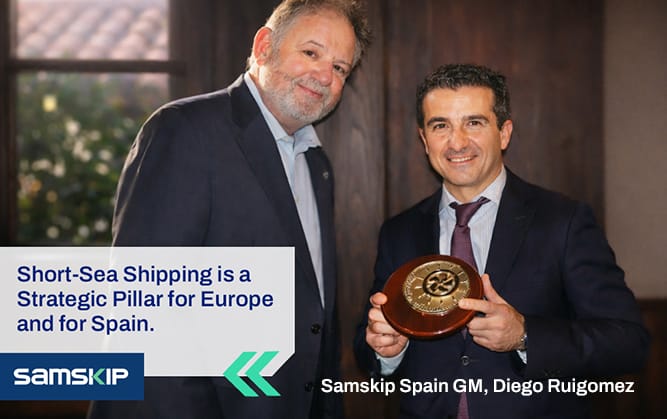
This year, at the Propeller Forum in Madrid, Diego Ruigómez, General Manager Spain at Samskip, presented a clear and confident vision for the present and future of Short Sea Shipping in Europe broadly, and in Spain specifically.
“It was a real pleasure to reconnect with colleagues from across the sector,” Diego shared. “Some of us remember when sustainability was just starting to appear in maritime discussions. Today, it’s no longer a side topic. It’s central to every serious logistics strategy.”
In a market shaped by decarbonization targets, regulatory shifts, and geopolitical volatility, one message stood out: rail and maritime integration are not optional for Spain. They are essential.
With 1.6 billion tonnes of intra-European short-sea cargo moving annually, Short Sea Shipping continues to demonstrate resilience and stability. But for Spain, given its size, geography, and long inland distances, the competitive advantage lies firmly in multimodality.
“Spain is particularly dependent on efficient intermodal solutions,” Diego explained. “Our geographical position and logistics configuration make strong rail-to-port connections critical, especially through the ports of northern Spain for links with the United Kingdom, Ireland, and Northern Europe.”
He pointed in particular to the transformation underway in Santander, highlighting the growth of the Port of Santander over the past two years. Improved rail access and the development of a new container terminal focused on short-sea services are already strengthening Spain’s competitive position.
“The Madrid–Santander corridor is a powerful example,” Diego noted. “When rail and sea work together, the result is both operationally reliable and dramatically more sustainable. Multimodal transport produces less than a third of the CO₂ emissions compared to road-only transport. And increasingly, it’s also the most economically competitive option.”
At Samskip, this vision is being translated into action through three clear priorities:
- Promoting multimodal transport with intensive use of rail connections to our vessels
- Decarbonizing our fleet
- Investing in alternative fuels, including hydrogen-powered solutions
“Our commitment to more sustainable transport is not theoretical,” Diego emphasized. “It’s something we are actively implementing every day through infrastructure, through fleet development, and through innovation.”
Meanwhile, the regulatory landscape continues to evolve rapidly, with frameworks such as EU ETS and FuelEU Maritime reshaping cost structures across all transport modes. Companies that adapt early and embrace multimodal solutions will be the ones that lead.
“We are at a turning point,” Diego concluded. “Short Sea Shipping is no longer an alternative. It is a strategic pillar for Europe, and especially for Spain. The transition is already underway. The real question is how quickly we move.”
Samskip is proud to contribute to these conversations in forums like the Propeller Club of Madrid, helping shape a logistics future that is competitive, resilient, and sustainable.
The direction is clear. The momentum is building. And Spain is ready to lead.

